
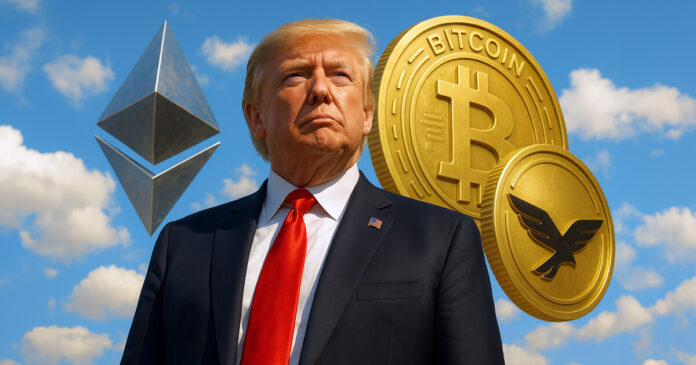
Introduction to Trump’s Crypto Empire
A recent staff report released by House Judiciary Committee member Jamie Raskin has shed light on the alleged use of the presidency by President Donald Trump to increase his personal wealth through cryptocurrency projects. The report, titled “Trump, Crypto, and a New Age of Corruption,” presents a series of findings that suggest the administration’s policy decisions have directly benefited the president’s personal financial interests.
Trump’s Cryptocurrency Portfolio
According to the document, President Trump’s cryptocurrency portfolio is valued at up to $11.6 billion, with revenue from the sale of crypto assets exceeding $800 million in the first half of 2025 alone. The report argues that the president’s holdings in World Liberty Financial (WLF) and the memecoin TRUMP create a structural conflict of interest that current federal ethics laws are ill-suited to address. The committee staff also alleges that foreign and corporate actors have used these digital asset platforms to funnel capital into the president’s ventures, effectively circumventing traditional campaign finance restrictions.
Shadow Lobbying and Regulatory Policy
The report focuses on the mechanism through which the president’s family business allegedly receives funds, describing a dynamic in which “foreign actors and corporate interests” are purchasing tokens or providing liquidity to Trump-linked decentralized finance (DeFi) protocols. The report argues that these transactions amount to unregulated lobbying, unlike traditional political donations, which are capped and disclosed to the Federal Election Commission (FEC). The committee staff claims that by owning governance tokens instead of traditional equity, the president is profiting from a price surge caused by his own policy announcements, a dynamic the report calls “self-trading.”
National Security Concerns and Loopholes in the Law
Beyond domestic fiscal policy, the report raises national security concerns about the government’s dealings with foreign companies, detailing an alleged transaction between MGX, a UAE-based investment firm, and G42, a technology holding company. The report claims that White House officials, including Steve Witkoff, co-founder of World Liberty Financial, negotiated to give G42 access to advanced US-made artificial intelligence (AI) chips, despite objections from the National Security Council (NSC) regarding possible technology diversion to China. The report concludes by identifying “serious weaknesses” in current anti-bribery and conflict of interest laws, arguing that laws such as the Foreign Agents Registration Act (FARA) and domestic bribery laws are based on traditional financial instruments and do not adequately cover decentralized digital assets.
Conclusion and Call for Reform
The report warns that without legal reform, the “pseudonymous” nature of cryptocurrency creates a new channel of influence that is technically legal but ethically questionable. Therefore, Raskin calls for immediate congressional reforms to close these gaps and restore “accountability and integrity” to the executive branch. As of press time, the White House has not yet issued a formal response to the specific allegations regarding the firing of NSC employees or the method cited in the report for valuing the president’s holdings at $11.6 billion. For more information, visit the source link: https://cryptoslate.com/how-trumps-crypto-empire-became-the-center-of-a-new-influence-economy/

