
Decentralized AI Network Cocoon Goes Live on The Open Network
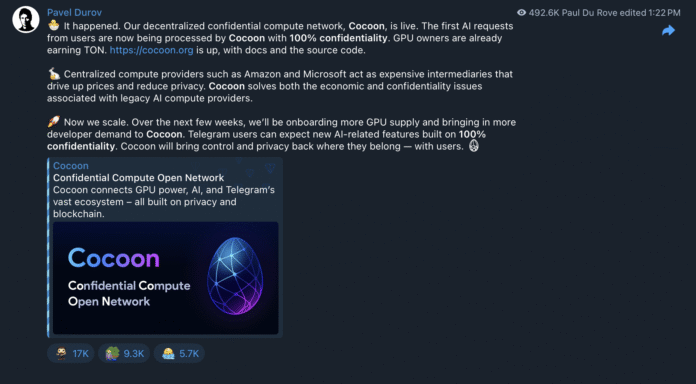
Decentralized AI network Cocoon, a privacy-preserving distributed computing platform based on The Open Network (TON) – an independent Layer 1 blockchain connected to the messaging application Telegram – went live on Sunday. This development marks a significant milestone in the quest for decentralized AI solutions, as it enables graphics processing unit (GPU) owners to rent their computing power to the network and process user requests in return for Toncoin (TON), the native token of the TON blockchain.
The decentralized AI network has already processed the first requests from users, and GPU owners are benefiting from renting out their hardware, according to Telegram co-founder Pavel Durov. He emphasized the importance of decentralized computing, stating: “Centralized computing providers like Amazon and Microsoft act as expensive intermediaries, driving up prices and limiting privacy. Cocoon solves both the economic and confidentiality problems associated with legacy AI computing providers.” 
Durov announced the release of Cocoon in October at the Blockchain Life 2025 conference in Dubai, United Arab Emirates (UAE), in response to user demand for an AI platform that would protect the privacy and data of large, centralized AI service providers. The blockchain community, privacy advocates, and cypherpunks have long warned about the negative social impacts of centralized AI and advocated for decentralized AI networks as a public good. 
Decentralized AI and Self-Sovereignty: An Antidote to Centralized Dystopia
Centralized AI systems give governments and companies enormous influence over individuals, which can compromise user privacy, compromise traditional cybersecurity measures, and lead to social conditioning by organized actors, according to David Holtzman, chief strategy officer at decentralized security protocol Naoris. These threats can be mitigated by applying blockchain technology to AI to verify information sources, ensure tamper-proof records, and enable nodes in distributed computer networks to communicate in a trustworthy manner.
In 2024, AI researchers at the Dfinity Foundation, the nonprofit organization guiding the development of the Internet Computer Protocol (ICP), and executives at decentralized AI developer Onicai outlined seven rules for ensuring ethical AI. This included running AI over permissionless blockchain networks to ensure transparency and data integrity. A survey conducted in May by the Digital Currency Group (DCG) found that 77% of 2,036 respondents said decentralized AI would benefit society more than centralized systems.
For more information, read the full article on Cointelegraph.

