
Bitcoin’s Struggle to Break $90,000: Understanding the Factors at Play
Bitcoin (BTC) has been facing significant challenges in breaking the $90,000 mark, prompting market analysts to explore various explanations for this price weakness. While some attribute the decline to market manipulation or concerns about artificial intelligence, there is no concrete evidence to support these claims. Instead, a closer examination of market trends and economic indicators reveals a more nuanced picture.
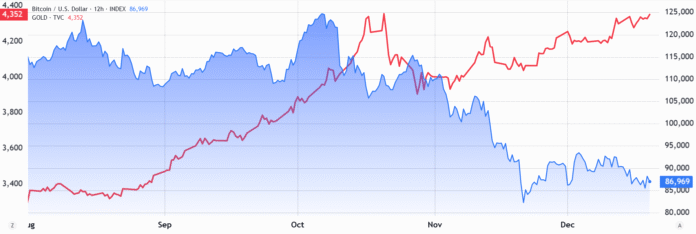
The S&P 500 has been trading near its all-time high, with a mere 1.3% decline, whereas Bitcoin remains 30% below its October high of $126,200. This divergence suggests increased risk aversion among traders, undermining the narrative that fears of an AI bubble are driving overall market weakness.  Gold/USD (left) vs. Bitcoin/USD (right). Source: TradingView
Despite Bitcoin’s decentralized nature and long-term appeal, gold has emerged as a preferred hedge amid ongoing economic uncertainty. The Federal Reserve’s reduction of its balance sheet throughout most of 2025 has limited Bitcoin’s ability to break $90,000, as this strategy aims to drain liquidity from financial markets.
Fed Balance Sheet Reduction and Its Impact on Bitcoin
The Fed’s balance sheet reduction has been a key factor in limiting Bitcoin’s growth. However, this trend reversed in December, with signs of labor market deterioration and weaker consumer data raising concerns about future economic growth. Retailers such as Target and Macy’s have cut their profit outlook, while Nike reported a decline in quarterly sales, causing shares to fall 10%. Historically, lower consumer spending creates a bearish environment for riskier assets like Bitcoin.
 Fed Target Interest Rate Probabilities for January 2026 FOMC. Source: CME FedWatch Tool
According to the CME FedWatch Tool, the probability of a rate cut at the Jan. 28 FOMC meeting fell to 22% on Friday from 24% the previous week. Demand for U.S. Treasury bonds remained steady, with the 10-year yield at 4.15% on Friday, signaling growing risk aversion among traders and contributing to weaker demand for Bitcoin.
Economic Weakness in Japan and Its Impact on Bitcoin
 S&P 500 Index 40-day correlation vs. Bitcoin/USD. Source: TradingView
Bitcoin’s correlation with traditional markets has decreased, but this does not mean that cryptocurrency investors are immune from weaker economic conditions. Weak demand for Japanese government bonds has increased the risk of contagion, as the country faces 10-year bond yields above 2% for the first time since 1999. Japan’s 2.3% annualized GDP decline in the third quarter is notable, given its negative interest rates and reliance on currency devaluations to stimulate economic activity for over a decade.
Bitcoin’s struggle near $90,000 reflects uncertainty over global growth and weaker U.S. jobs data. As investors become more risk-averse, the positive impact of lower interest rates and incentives for risky assets diminishes. Therefore, even if inflation picks up again, it is unlikely that Bitcoin will serve as an alternative hedge in the short term.
This article is for general information purposes and is not intended to constitute, and should not be construed as, legal, tax, investment, financial, or other advice. The views, thoughts, and opinions expressed herein are those of the author alone and do not necessarily reflect the views and opinions of Cointelegraph. While we strive to provide accurate and up-to-date information, Cointelegraph does not guarantee the accuracy, completeness, or reliability of the information in this article. This article may contain forward-looking statements that are subject to risks and uncertainties. Cointelegraph will not be liable for any loss or damage arising from your reliance on this information.
For more information on Bitcoin and market trends, visit Cointelegraph.

