
Privacy-Focused Cryptocurrencies Shine in Q4 Amid Market Turbulence
The digital assets space has just concluded a tumultuous quarter, marked by significant losses, strained market infrastructure, and widespread investor disappointment. However, one area of the market managed to buck this trend: privacy-focused cryptocurrencies. According to Grayscale’s latest quarterly market summary, privacy emerged as an unexpected investment theme in the fourth quarter, with assets such as Zcash (ZEC) significantly outperforming the broader crypto market.
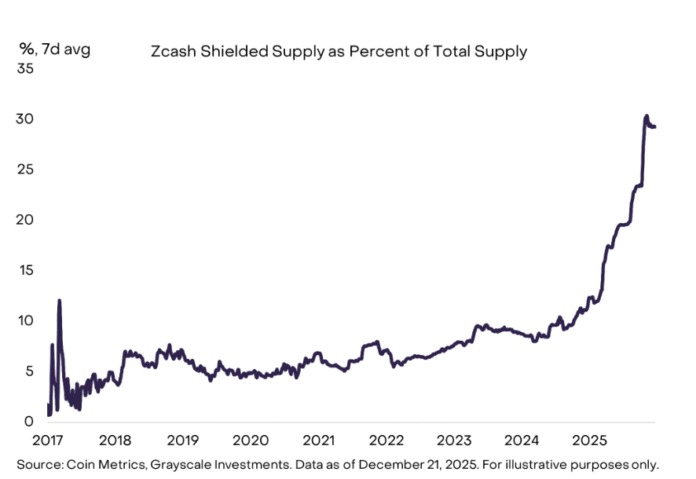
The price of Zcash surged in the fourth quarter, rising from around $50 in mid-September to a high of nearly $700 in mid-November, data from CoinMarketCap shows. This performance coincided with a sharp increase in Zcash’s use of protected addresses, which hide transaction details such as sender, recipient, and amount.

Other privacy-friendly cryptocurrencies also posted relative gains in the quarter, including long-established projects such as Monero (XMR) and Dash (DASH), highlighting renewed investor interest in privacy-focused blockchains. This trend is not surprising, given the growing concern over data privacy and security in the digital age.
Defensive Positioning in the Private Sphere
Grayscale attributed the unexpected rise in privacy-focused cryptocurrencies in part to what it called “more defensive positioning within crypto markets.” In Grayscale’s industry framework, these privacy tokens fall into the “currencies” subsector, which includes assets used primarily as mediums of exchange or stores of value rather than as application platforms.
While the currencies subsector fell more than 15% during the quarter, it still performed significantly better than other segments, including financials, smart contract platforms, consumer and culture, and artificial intelligence. Historically, defensive positioning in crypto markets has often focused on Bitcoin (BTC), which some investors viewed as a form of digital gold during times of macroeconomic uncertainty.

However, in recent years, Bitcoin has tended to trade more closely in line with broader stock markets, particularly technology stocks. This relationship showed signs of strain in the fourth quarter as correlations weakened due to structural tensions across the crypto sector, including the market-wide liquidation on October 10, which analysts described as “controlled deleveraging.”
For more information on the rise of privacy-focused cryptocurrencies, read the full article on Cointelegraph.

