
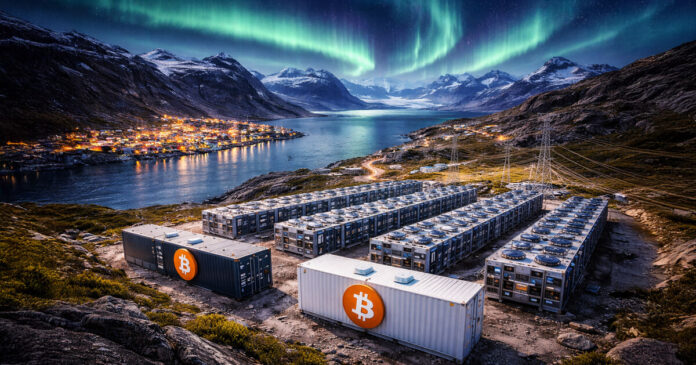
Greenland’s Energy Potential: A New Frontier for Bitcoin Mining
The discussion over the US purchase of Greenland has resurfaced in Washington, and with it, the potential for miners to tap into the island’s vast energy resources. According to Reuters, the White House has confirmed that a US purchase of Greenland is an “active discussion.” For Bitcoin miners, the focus is on Greenland’s industrial energy planning, which could provide a significant boost to their operations.
Greenland’s government plans to open a public tender round for two of the largest mapped hydropower sites, Tasersiaq and Tarsartuup Tasersua, in the second half of 2026. These sites have the potential to produce over 9,500 gigawatt hours annually, making them an attractive option for miners. To put this into perspective, Bitmain’s Antminer S21 specification lists 200 TH/s at 3,500 watts, or about 17.5 joules per terahash.
Calculating Bitcoin Mining Capacity in Greenland
Using the planned power consumption effectiveness value of approximately 1.1, 1 megawatt of plant output corresponds to approximately 0.052 exahash per second (EH/s) at 17.5 J/TH. This implies a hashrate cap of around 0.041-0.061 EH/s over an efficiency band of 15-22 J/TH. The table below illustrates the estimated hashrate cap based on system output:
| System output (MW) | Hashrate cap (EH/s) at 17.5 J/TH, PUE 1.1 |
|---|---|
| 5 | 0.26 |
| 25 | 1.30 |
| 50 | 2.60 |
| 100 | 5.19 |
While the current installed base in Greenland is relatively small, the potential for expansion is significant. According to Nukissiorfiit’s annual report, the average electricity sales price in 2024 was around 1.81 DKK per kilowatt hour. However, retail prices do not directly translate to mining economics, and large-scale construction depends on industrial power purchase agreements or behind-the-meter delivery.
Scaling Bitcoin Mining in Greenland: Challenges and Opportunities
The lack of a national grid limits opportunities for scaling, and power plants generally serve local systems with limited connectivity. This pushes early “stranded” or surplus energy concepts to colocate flexible loads in specific facilities. The Greenland Review discusses the use of surplus energy in the context of reducing energy costs. If 5-25 megawatts can be aggregated behind the meter close to existing generation, the upper limit is about 0.21-1.52 EH/s over the 15-22 J/TH band.
The next stage is Nuuk’s main hydroelectric power station, which is scheduled for expansion from 45 megawatts to 121 megawatts. Construction is set to begin in 2026 and commissioning is scheduled for 2032. If 50-121 megawatts of power were allocated to miners, the electrical cap is about 2.07-7.33 EH/s over the 15-22 J/TH band. This assumes that these megawatts are not absorbed by Nuuk’s demand growth and electrification plans.
Trump-Linked Capital and Greenland’s Energy Surplus
Trump-linked mining capital is already forming, and Greenland’s energy calendar could attract attention within the sector. Hut 8 partnered with Eric Trump to launch American Bitcoin, combining Hut 8’s mining operations with a group of investors that includes Donald Trump Jr. The company reported an installed computing power of approximately 24 EH/s and fleet efficiency of around 16.4 J/TH as of September 1, 2025.
Using the same PUE 1.1 planning value, 24 EH/s represents approximately 430 megawatts of plant capacity at 16.4 J/TH. A fully utilized 1.08 GW tender expansion could power an American Bitcoin fleet more than once if the offtake was for mining and the transmission and construction schedules were met.
Geopolitics and the Future of Bitcoin Mining in Greenland
The International Energy Agency has warned that AI will lead to higher electricity demands from data centers, which may increase the opportunity cost of providing long-term renewable energy for mining. Diplomacy will shape the financing conditions around any “Trump-Greenland mine” thesis. European officials have stressed that Greenland’s status is based on consent and sovereignty norms.
Greenland’s tender round, scheduled for the second half of 2026, will lay the foundation for large-scale Bitcoin mining offtake from new hydropower on the island. However, if Greenland were brought under US jurisdiction and treated as an energy development zone, the cap on renewable energy relevant to mining would shift from 1 GW-class hydropower tenders to wind tenders. According to a systems study published in Energy, Greenland’s technical onshore wind power potential is approximately 333 GW, producing around 1,487 TWh per year.
On an energy basis, this corresponds to an average generation of around 170 GW. Output would be variable, requiring transmission, superstructure, truncation, storage, and solidification to provide large-scale 24/7 load. Translating this pure energy cap into hashrate shows how far the “Trump Greenland Mine” narrative can theoretically be pushed. At 15-22 J/TH with a PUE of around 1.1, 170 GW of average generation means around 7.0-10.4 ZH/s hashing capacity if miners could absorb the average power as a flexible load.
Read more about the potential for Bitcoin mining in Greenland at Cryptoslate.

