
Bank of Italy Examines Ethereum’s Security and Transactional Risks in Event of Ether Price Collapse
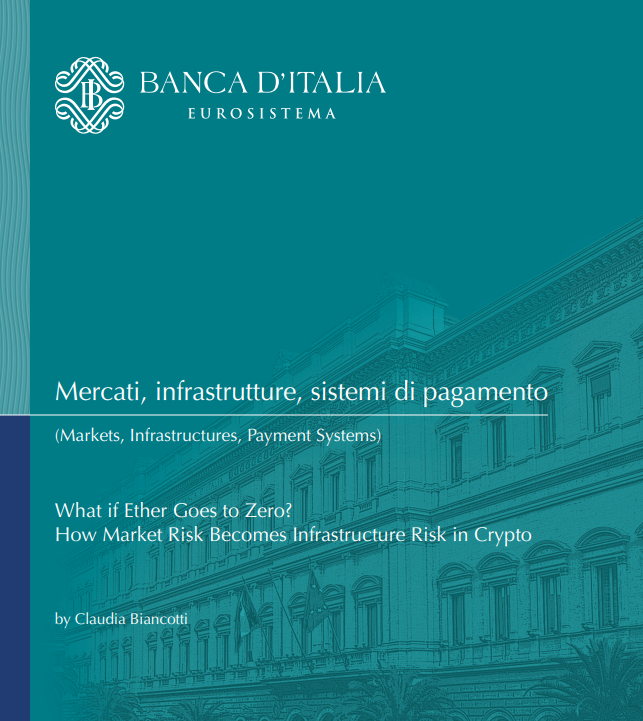
The Bank of Italy has conducted a comprehensive study to assess the potential consequences on Ethereum’s security and transactional capabilities if the price of Ether were to plummet to zero. This research treats the Ethereum network as a critical component of financial infrastructure, rather than merely a speculative cryptocurrency. In a research paper titled “What if Ether Goes to Zero? How Market Risk Becomes Infrastructure Risk in Cryptocurrencies,” economist Claudia Biancotti delves into the potential impact of an extreme Ether price shock on Ethereum-based financial services that rely on the network for transaction processing and settlement.
Biancotti’s study focuses on the intricate relationship between validators’ economic incentives and the stability of the underlying blockchain, which is utilized by stablecoins and other tokenized assets. The paper models how validators, who are rewarded in ETH, might respond if the token’s price were to collapse, rendering their rewards virtually worthless. In this scenario, a significant portion of validators would likely exit, thereby reducing the overall stake required to secure the network, slowing block production, and weakening Ethereum’s ability to withstand certain attacks and ensure the timely, final settlement of transactions.
Understanding the Intersection of Market Risk and Infrastructure Risk
The study views Ether not merely as a volatile investment, but as a core input to the settlement infrastructure that underpins a growing share of on-chain financial activity. This perspective allows the Bank of Italy to examine how market risk associated with the base token could translate into operational and infrastructure risks for instruments built upon it, including fiat-backed stablecoins and tokenized securities whose transaction ordering and finality depend on Ethereum.  What happens if Ether goes to zero? Source: Bank of Italy
This framework enables the tracking of how disruptions in such a stress event would not be limited to speculative trading but could also spill over into payments and settlement use cases, which are increasingly being monitored by regulators. The International Monetary Fund and the European Central Bank (ECB) have also warned about the potential systemic importance of large stablecoins and their risk to financial stability if they continue to expand rapidly and remain concentrated in a handful of issuers.
Regulatory Considerations and the Future of Public Blockchains in Financial Services
The ECB has noted that the structural vulnerabilities of stablecoins and their links to traditional finance mean that a severe shock could trigger runs, fire sales of assets, and deposit outflows, particularly if adoption expands beyond crypto trading. The Bank of Italy concludes that regulators face a challenging trade-off regarding whether and how regulated intermediaries should be allowed to use public blockchains for financial services. Two potential options are outlined: treating public chains as unsuitable for use in regulated financial infrastructures due to their reliance on volatile native tokens, or allowing their use while mandating risk mitigation measures such as business continuity plans, emergency chains, and minimum standards for economic security and validators.
For more information on this topic, visit https://cointelegraph.com/news/bank-of-italy-ethereum-security-ether-price-risk?utm_source=rss_feed&utm_medium=rss_tag_blockchain&utm_campaign=rss_partner_inbound

