

Bitcoin ETFs Experience Significant Outflows Amidst Market Uncertainty
Bitcoin spot exchange-traded funds (ETFs) have witnessed substantial outflows over the past four trading days, with a combined total of $1.62 billion being withdrawn. This significant exit has raised questions about whether hedge funds are reducing their Bitcoin exposure as market conditions continue to evolve. The withdrawals come as Bitcoin struggles to regain momentum around critical price points, while a once-popular institutional arbitrage strategy steadily loses its appeal.
The data from Sosovalue shows that US-listed spot Bitcoin ETFs recorded net daily outflows of $32.11 million as of January 22, 2026, extending a streak of redemptions that peaked at $708.71 million on January 21. In the last week, net outflows amounted to $1.22 billion, indicating a notable shift in investor sentiment. Despite this, trading activity remained strong on January 22, with Bitcoin spot ETFs recording $3.30 billion in volume, even as assets under management dipped to $115.99 billion, about 6.49% of Bitcoin’s market cap.

BlackRock’s IBIT Leads Bitcoin ETF Outflows as BTC Slips Below $90K
BlackRock’s iShares Bitcoin Trust led daily outflows, with $22.35 million redeemed, equivalent to roughly 249.5 BTC. Despite the withdrawal, IBIT remains the dominant product, holding $69.84 billion in assets and nearly 4% of the Bitcoin supply represented in ETFs. Fidelity’s FBTC followed with $9.76 million in outflows, while Grayscale’s GBTC reported flat daily flows but remains deeply negative overall, with $25.58 billion in cumulative net outflows as investors continue rotating away from its higher 1.5% fee.

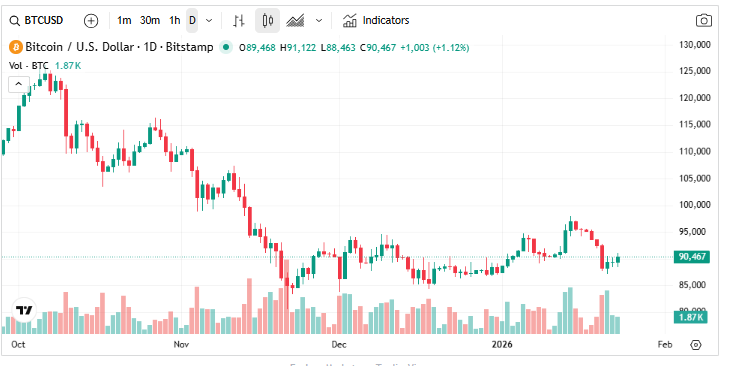
Bitcoin ETFs data Source: Sosovalue. The ETF pullback has unfolded alongside weakness in Bitcoin’s price, with BTC trading around $89,982 on January 22, down 1.3% on the day and nearly 5% over the past week, after briefly dipping to $88,600.
Compressed Yields Trigger Hedge Fund Exit From Bitcoin ETFs
Market observers point to hedge fund positioning as a key driver behind the ETF outflows. Amberdata shows that yields on the Bitcoin basis trade, a strategy that buys spot Bitcoin via ETFs while selling futures to capture price spreads, have dropped below 5%, down from around 17% a year ago. As returns compress and approach the yield available on short-dated US Treasuries, fast-moving capital has less incentive to stay deployed.
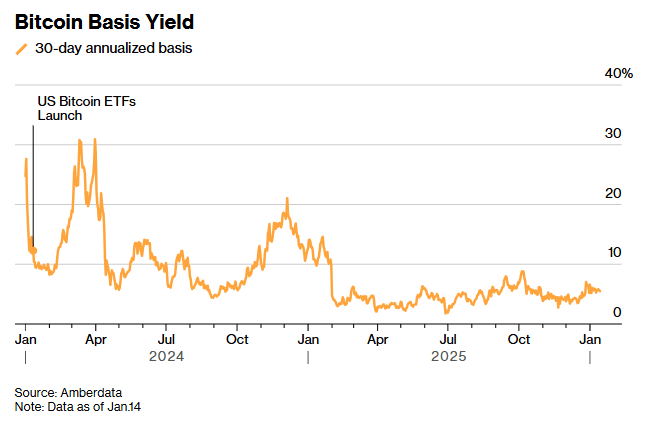
Source: Amberdata. CryptoQuant indicators show apparent demand turning negative, whale and dolphin wallets shifting from accumulation to distribution. Also, the Coinbase premium remained deeply negative, suggesting weaker appetite from US institutions.
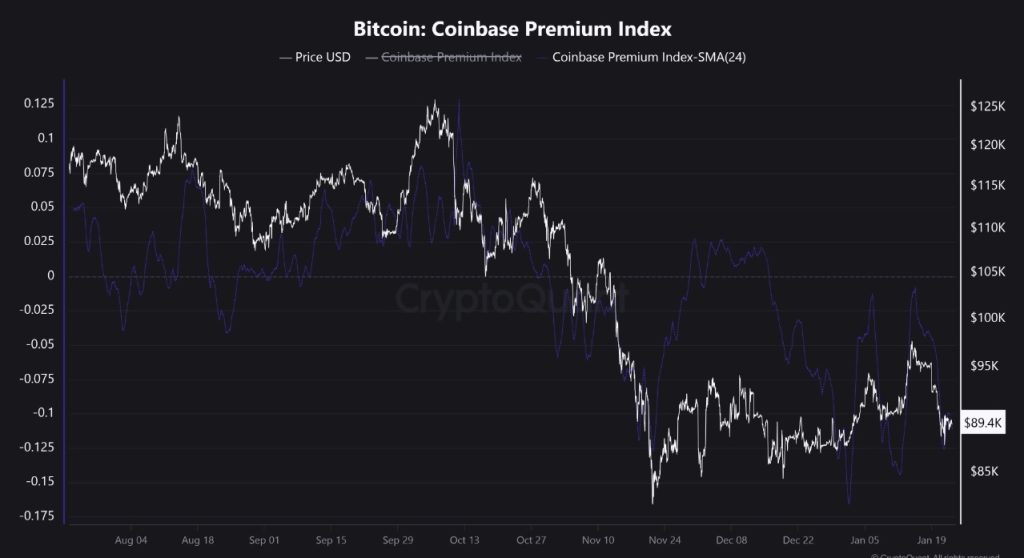
Source: CryptoQuant. At the same time, leverage in Bitcoin futures has climbed to its highest level since November, increasing the market’s sensitivity to sharp moves in either direction. Flows in other crypto ETFs underline that the sell-off is not uniform. Ethereum spot ETFs also recorded heavy outflows this week, including $41.98 million on January 22, while XRP and Solana-linked products saw modest inflows, pointing to selective institutional repositioning rather than a wholesale exit from digital assets.
For more information, visit the original source: https://cryptonews.com/news/bitcoin-etfs-lose-1-62b-basis-trade-crash/

