
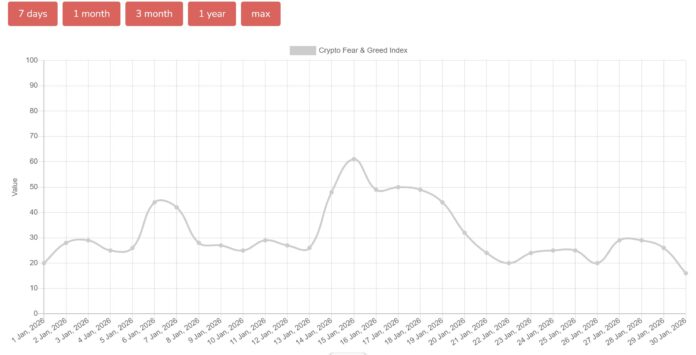
Bitcoin’s price has experienced a significant drop of 14.5% over the past 16 days, resulting in the Crypto Fear & Greed Index reaching its lowest rating of the year at 16, indicating “Extreme Fear”. This downturn has led to a dominant selling trend in the markets, but Bitcoin derivatives data suggests that the current trader positioning may pave the way for a potential recovery. Analysts are now assessing whether the recent sell-off has created the conditions for a relief rally.

The Crypto Fear & Greed Index, which measures market sentiment, has been influenced by the recent price drop. The index is currently at its lowest point for the year, indicating a high level of fear among investors. However, this fear may be an opportunity for a relief rally, as it often precedes a market rebound.
Market Imbalance and Potential for a Relief Rally
From a technical standpoint, Bitcoin has cleared a large cluster of long liquidations, with its swing lows between $80,000 and $83,000. This has shifted attention to higher price levels. CoinGlass data shows that a move toward $92,000 may put over $6.5 billion in cumulative short positions at risk of liquidation, while a drop to $72,600 would only threaten about $1.2 billion. This imbalance could lead to short sellers being forced to buy back positions, potentially accelerating a price recovery.

A crypto commentator, MartyParty, has framed the recent move as part of a Wyckoff Accumulation “Spring”, where the price briefly dips below support to shake out weak hands before reversing. The sweep below $83,000 may act as a final liquidity grab, allowing larger participants to buy discounted Bitcoin. If followed by sustained buying, the next phase may exhibit a price expansion with upside targets extending back toward $100,000.

Bitcoin Futures Positioning Shows Mixed Signals
Bitcoin’s decline triggered an estimated $800 billion in liquidations over the past 24 hours, the largest single-day event since late November. However, according to crypto analyst Darkfost, the open interest on Binance has risen to 123,500 BTC, exceeding levels seen ahead of October 10, when open interest fell to 93,600 BTC. A roughly 31% increase since then suggests traders are rebuilding exposure rather than fully exiting the market.

Broader derivatives activity has also cooled, with monthly Bitcoin futures volume across all exchanges falling to about $1.09 trillion in January, the lowest since 2024. Trading remained concentrated on major venues, led by Binance with $378 billion, followed by OKX at $169 billion and Bybit near $156 billion. For more information, please visit the original source.

This article does not contain investment advice or recommendations. Every investment and trading move involves risk, and readers should conduct their own research when making a decision. For the latest Bitcoin news and updates, follow the link to the original article.

