
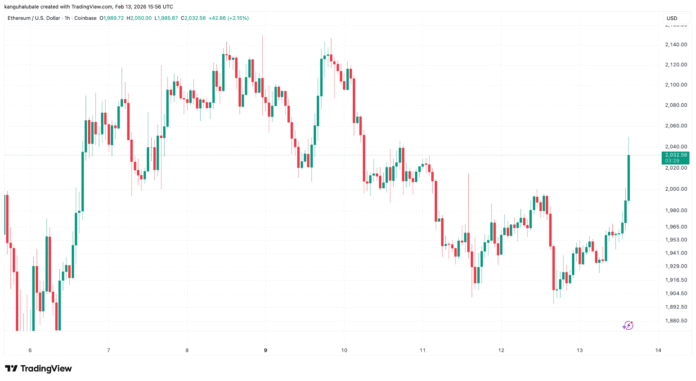
Ether (ETH) has made a significant comeback, trading above $2,000 on Friday, following the release of the U.S. Consumer Price Index (CPI) report, which showed a cooler-than-expected inflation rate. This rally has put ETH/USD on track for its first bullish weekly candle close since mid-January, sparking speculation about a potential rally towards $2,500.
The recent surge in Ether’s price can be attributed to a combination of factors, including a decline in open interest in Ether futures and a significant drop in funding rates. According to data from CryptoQuant, open interest in Ether futures on all major exchanges has fallen by over 80 million ETH in the last 30 days. This decline suggests that leveraged traders are reducing their exposure rather than opening new positions, which could pave the way for a period of relative stability or the formation of a more solid price base for Ethereum in the near future.
Decline in Open Interest and Funding Rates
The decline in open interest in Ether futures is a widespread phenomenon, with major exchanges such as Binance, Gate, Bybit, and OKX all recording significant drops. Binance, the world’s largest cryptocurrency exchange by trading volume, saw the largest decline, with open interest falling by around 40 million ETH (50%) in the last 30 days. This significant decline in open interest amid falling prices can be seen as a clean-up of weaker positions, thereby reducing the likelihood of drastic forced liquidations down the road.
The financing interest rates for Ether futures on Binance have also plunged deep into negative territory at -0.006, marking the lowest value since the beginning of December 2022. This suggests that bearish sentiment has reached an extreme peak not seen in the last three years. Historically, a short squeeze is often preceded by extremely negative financing rates with high levels of price support. The current data suggests that we may be witnessing a classic capitulation event, mirroring the bottom formed in late 2022 and potentially setting the stage for a strong recovery.
Technical Analysis of ETH Price
The ETH/USD pair broke out of a falling wedge on the four-hour chart and was trading at $2,050 at the time of writing. The measured target of the falling wedge, calculated by adding the maximum height of the wedge to the breakout point at $1,950, is $2,150. Furthermore, the price could rise to retest the 100-period simple moving average (SMA) at $2,260 and later towards $2,500.

On the other hand, an important area to hold is the psychological level of $2,000, which is enclosed by the 50-period SMA. Glassnode’s cost base distribution heatmap shows a recently established significant support area between $1,880 and $1,900, where investors have purchased around 1.3 million ETH.


This article does not contain any investment advice or recommendations. Every investment and trading activity involves risks, and readers should conduct their own research when making their decision. While we strive to provide accurate and up-to-date information, Cointelegraph does not guarantee the accuracy, completeness, or reliability of the information in this article. This article may contain forward-looking statements that are subject to risks and uncertainties. Cointelegraph will not be liable for any loss or damage arising from your reliance on this information. For more information, visit https://cointelegraph.com/news/eth-open-interest-falls-to-3-year-low-what-does-it-mean-for-ether-price

