
The Digital Asset Market Clarity (CLARITY) Act has sparked a heated debate in the cryptocurrency industry, with the January 15 markup date missed and pushed back to the end of the month. At the center of the controversy is the question of who will control the on-chain median US dollar yield: open decentralized finance (DeFi) protocols and payment rails or a select group of large custodians and banks. Critics, including stablecoin issuers and institutional DeFi platforms, warn that the bill risks driving on-chain lending abroad rather than making it safer in the United States.
The Industry’s Concerns
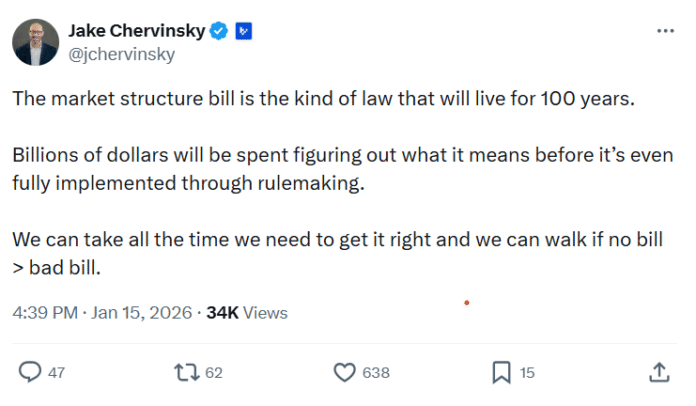
Coinbase’s decision to withdraw support for the bill has highlighted the growing unrest in the industry. The company’s CEO, Brian Armstrong, argued that it was better to have “no bill than a bad bill,” while Jake Chervinsky, chief legal officer at Variant Fund, stated that CLARITY was the type of law that “would last for 100 years,” and “We can take the time we need to get it right.”  CLARITY will “live 100 years”. Source: Jake Chervinsky
Coinbase CEO expects market structure calculation markup “in a few weeks”. The CLARITY Act has significant implications for on-chain dollar returns, with regulators deciding where returns can be earned, not how risk is managed in on-chain markets. Jakob Kronbichler, CEO and co-founder of on-chain lending marketplace Clearpool, spoke to Cointelegraph about the “core risk” of the CLARITY Act.
Impact on DeFi and Stablecoin Yields
Demand for dollar yields will not disappear as a result of the legislation, according to Kronbichler, but activity “will likely shift offshore or be concentrated among a small number of established intermediaries as compliant on-chain liquidity structures are restricted.” Ron Tarter, CEO of stablecoin issuer MNEE and a former attorney, echoed Kronbichler’s concerns, stating that “If stablecoin rewards are moved offshore rather than made transparent and compliant onshore, the US risks losing both innovation and visibility in these markets.”
The choice will influence the development of institutional on-chain credit over the next decade, warned Kronbichler. Tarter interprets CLARITY as a conscious separation between passive, deposit-like interest and activity-based incentives, adding that the key pivot point is the wording “solely in connection with holding”. The bill attempts to mediate between banking groups that fear stablecoin yields could weigh on deposits and platforms that see rewards as their main source of revenue and incentive.
DeFi, Developers, and the Line of Control
For now, Kronbichler sees a bright spot: CLARITY’s current approach “makes a meaningful distinction by not treating developers of non-custodial software as financial intermediaries,” which he calls crucial to innovation and institutional comfort. The real challenge, he says, is tying compliance obligations to companies that actually control access, custody, or risk parameters, rather than focusing on general software maintainers that don’t.
Tarter agrees that developer control testing is likely to be one of the most contentious flashpoints in markup, and expects heated debates about what counts as truly decentralized software and “situations where a small group can substantially control the results.” Anvil – Data Analysis for the Bitcoin Lightning Network – CEO Jesse Shrader sees a real consumer protection issue in “just for holding” rewards that disguise dilution or re-staking, pointing to previous failures like Celsius and BlockFi.
Honest Returns and Network Activity
Shrader draws a sharp line between opaque, platform-defined returns and activity-derived returns, which he argues are more transparent from a network design perspective. For lawmakers who want to preserve this distinction, Shrader’s first demand is simple: require regulated tokens to “clearly disclose the sources of their yield so that consumers can adequately assess their risk.” What kind of CLARITY outcome would truly protect users without stifling compliant on-chain dollar markets for all stakeholders?
“A light response from regulators is appreciated,” said Shrader, while Tarter believes the victory comes from US policies that protect users “without banning compliant innovation” (and without setting a reward system that only the largest custodians can afford). For more information, visit Cointelegraph to stay up-to-date on the latest developments in the cryptocurrency industry.

