
Crypto Market Correction: Understanding the Recent Decline
The cryptocurrency market experienced a significant correction on Monday, with Bitcoin (BTC) retesting $85,000 and Ether (ETH) falling to $2,900. This downturn can be attributed to several factors, including growing caution among traders, tighter liquidity, and rising AI debt risks. According to a recent survey, worsening economic conditions in the United States and changing investor expectations about proposed options for the next Federal Reserve chair have also contributed to the market correction.
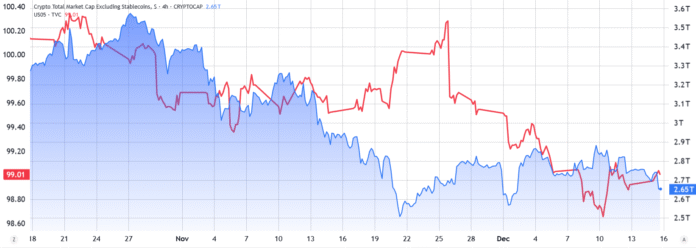
 Five-year US Treasury bonds (left) compared to total crypto capitalization, USD. Source: TradingView
Key Factors Contributing to the Market Correction
The resilience of US five-year Treasury bonds after hitting a low of 98.64 on Wednesday suggests more defensive positioning as liquidity conditions tightened in global markets. This caution comes amid increasing fiscal pressures after a recent tax and spending package extended credit and raised the U.S. debt ceiling by $5 trillion. Additionally, the Federal Reserve announced that it would begin purchasing about $40 billion of short-term Treasury securities per month as part of a technical reserve management operation to maintain sufficient liquidity.
Excessive leverage in the cryptocurrency market remains a major problem, with open interest in futures standing at $135 billion. Over $527 million worth of bullish leveraged positions have been liquidated in the last 24 hours, worrying traders that further downside could occur. The weakness in artificial intelligence has also prompted traders to increase their cash positions and exit riskier asset classes such as cryptocurrencies.
 Total Open Interest in Crypto Market, USD. Source: CoinGlass
Impact of AI Debt Risks and US Economic Conditions
Hedge fund giant Bridgewater Associates reportedly said tech firms’ heavy reliance on debt markets to fund AI investments has reached a dangerous stage, according to Reuters. “Going forward, there is a reasonable likelihood that we will soon find ourselves in a bubble,” Greg Jensen, Bridgewater’s co-chief investment officer, wrote in a note. The consumer sector remains a concern, as a CNBC poll found that 41% of Americans plan to spend less during the holidays this year, up from 35% in 2024.
 Annualized funding rate on Monday. Source: CoinGlass
Market Outlook and Future Prospects
The demand for leverage on short positions (seller positions) surged on Bybit, pushing the annual funding rate below zero. This unusual situation, where longs (buyers) are paid to keep their leveraged positions open, rarely lasts as arbitrage opportunities arise. Still, liquidity has become significantly tighter since the Oct. 10 crash, and some market makers are likely facing significant losses. The US Dollar Index (DXY) found support at the 98 level after four consecutive weeks of declines, suggesting higher confidence in the US government’s ability to avoid a recession.
 S&P 500 Index (left) vs. US Dollar Strength Index (right). Source: TradingView
Macro analyst Luke Gromen is bearish on Bitcoin, citing excessive leverage in the cryptocurrency market and overall macroeconomic uncertainty. Bitcoin and Ether are generally viewed as part of an independent financial system, so the relative strength of the US dollar reduces demand for alternative hedges. For more information on the current state of the cryptocurrency market, visit Cointelegraph.

