

Introduction to Decentralization’s Centralized Achilles’ Heel
The blockchain industry has long been touted as a beacon of decentralization, operating without geographical boundaries and functioning 24/7. However, a series of recent incidents has exposed a harsh reality: the infrastructure supporting these decentralized applications is, in fact, heavily centralized. This centralized infrastructure, responsible for connecting users to the blockchain, has become the weakest link in the chain, leading to significant financial losses and compromised user access.

Understanding the Risks: Bridging Attacks and Connectivity Issues
A closer examination of the losses incurred by the blockchain industry reveals that most of these losses stem from bridging attacks, API compromises, and routing logic errors. According to a security analysis, $2.47 billion was lost in 344 incidents in the first half of 2025, while $509 million was lost in the third quarter of 2025. Furthermore, around $1.71 billion was stolen through wallet compromises, and phishing attacks caused losses of approximately $410.7 million.
Most risk frameworks focus on protocol risk, calculating the probability of consensus failures in blockchains like Ethereum or Solana. However, the real burden lies in connectivity risk, which is rarely considered in threat models. The Garden Finance attack, where the team emphasized that the protocol was not affected but the system had to be paused during the investigation, is a prime example of connectivity risk.
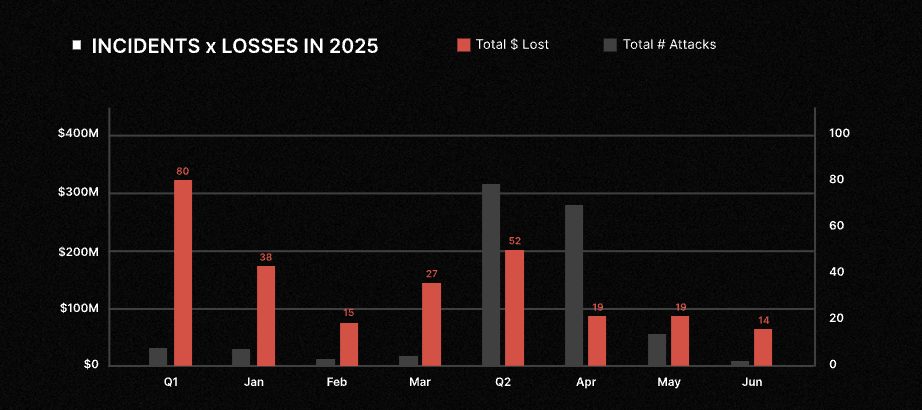 Source: Certik
The Collapse of Centralized Infrastructure
The Cloudflare outage, which affected users’ access to crypto exchanges, and the subsequent digital blackout that caused block explorers to go dark and DeFi dashboards to freeze, highlights the dependence of decentralized applications on centralized infrastructure. Despite the resilience of blockchain protocols, the collapse of this infrastructure can render them inaccessible.
A trader executing a swap on a decentralized exchange, for instance, relies on a sequence of components, including CDNs, DNS, RPC nodes, price oracles, and wallet providers. Any error in these components can halt the transaction, making the operational status of the blockchain irrelevant.
Institutional Involvement and the Need for Reliability
Institutional interest in crypto has increased significantly, with companies tokenizing real-world assets, building treasury products, and pushing for clearer custody rules. However, this growth rests on the assumption that users can access the blockchain when needed. Reliability is crucial, encompassing the entire dependency chain, from CDNs to custody APIs and bridge components.
A bank or tokenization platform will not be comforted by Ethereum’s daily transaction count or Byzantine fault tolerance if a custody connection fails during a major outage or a bridge exploit drains customer funds. In practice, risk has shifted away from consensus and toward the infrastructure connecting users to the blockchain.
The Urgent Need for Change
To address these issues, a standard practice for dependency mapping is necessary, including the decision on CDNs, DNS, RPC nodes, indexers, custody APIs, and bridging components. In the event of an outage, a plan must be created to ensure clear communication and automatic failover to alternative providers.
Regular checks and tests are essential to maintain network health, including testing bridges and routing layers like payment systems. Counterparties should verify that platforms have tested failover procedures for infrastructure failures, and regulators should consider more than just key storage when evaluating custody solutions.
For more information on this topic, please refer to the original article at https://cryptonews.com/exclusives/opinion-cryptos-real-problem-is-the-plumbing/

