
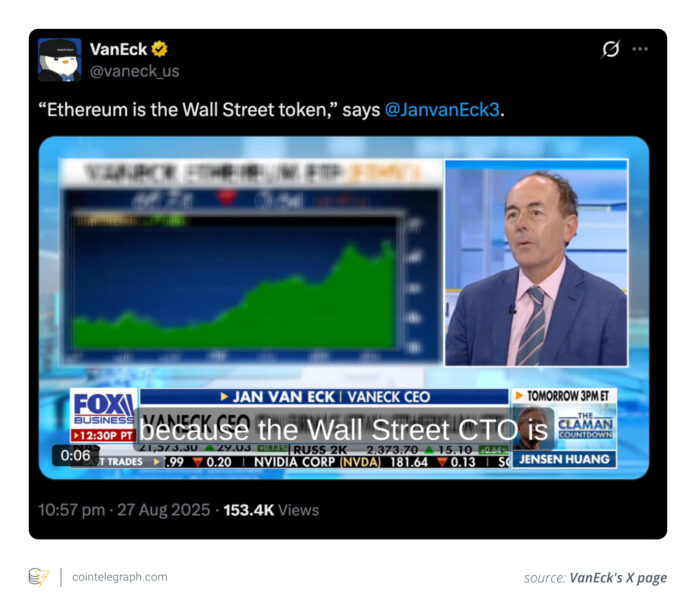
Introduction to Ethereum’s Adoption on Wall Street
Ethereum, once viewed as a platform primarily for digital art and assets, has undergone a significant transformation in the eyes of the financial world. By 2025, Wall Street had begun to see Ethereum as a basic utility, leveraging its capabilities to automate settlement processes, reduce reliance on manual reconciliation, and increase the efficiency of financial transactions. This shift is marked by the network’s ability to process over $5 trillion in quarterly transaction volume, comparable to traditional payment processors, and the increasing adoption of Ethereum as a settlement layer in institutional contexts.
Key Insights into Ethereum’s Financial Applications
Several key insights highlight Ethereum’s integration into the financial sector:
- Ethereum’s adoption is closely tied to its ability to automate settlement through smart contracts, reducing the need for slow, manual reconciliation processes.
- Stablecoins and tokenized dollars serve as the primary entry point for banks, enabling continuous settlement of regulated US dollar transfers on Ethereum-based rails.
- Financial institutions often avoid directly naming Ethereum, instead describing it as a neutral blockchain infrastructure that supports compliant financial systems.
- Tokenized funds and real-world assets use Ethereum as a distribution and management layer, while the underlying investments remain traditional financial products.
Ethereum as a Financial Instrument
To the average observer, Ethereum may be seen as a “coin” to be traded, but for Wall Street, it has become a high-tech financial asset. The network’s underlying architecture, the Ethereum Virtual Machine (EVM), is becoming a global standard for bank-to-bank settlements. Ethereum acts as a “single source of truth,” where transactions are verified by a global network of nodes rather than a central clearinghouse, enabling T+0 settlement and reducing the need for manual work done by middle office operations.
Instead of relying on routes that can take days to process, institutions are using Ethereum’s smart contracts to automate much of the manual work. This shift enables transactions to be settled instantly, moving from a T+2 basis to T+0, where asset transfer and payment occur simultaneously. Ethereum, in this context, acts as a fundamental infrastructure that allows the traditional financial system to function faster, at a lower cost, and with fewer errors.

Stablecoins and Tokenization as an Entry Point for Banks
The growth of “tokenized dollars” following the passage of the GENIUS Act in July 2025 has been significant, with the total market capitalization of these assets rising to $300 billion. For banks, stablecoins on Ethereum represent digital versions of the U.S. dollar that can move around the clock, avoiding the settlement risk associated with traditional bank hours and weekend closures. Traditional payments giants like Visa and Mastercard have integrated stablecoin settlement APIs to support global payments on the network, using Ethereum-based stablecoins to process transactions between merchants and banks in near real-time.
The GENIUS Act, which went into effect on July 18, 2025, was the first federal framework to officially authorize U.S. banks to issue stablecoins through subsidiaries, transforming Ethereum from a regulatory gray area to a compliant infrastructure layer for the US dollar.
Tokenized Funds and Real Assets on Ethereum
Ethereum’s development has moved beyond payments to the tokenization of more complex investment instruments. JPMorgan’s launch of its first money market fund on the public Ethereum blockchain, trading under the ticker symbol MONY, provides qualified investors with access to traditional U.S. Treasury yields using Ethereum as the distribution layer. This development enables peer-to-peer transferability and daily dividend reinvestment, with investors able to subscribe or redeem using cash or stablecoins through institutional platforms.
Ethereum acts as a digital wrapper that increases liquidity and operational efficiency in this structure, not as the investment itself. The automation of yield distribution through code allows these funds to operate with a level of precision and transparency that legacy databases cannot easily reproduce.
The Strategic Silence Around Ethereum’s Adoption
Despite its widespread adoption, Ethereum is often not mentioned by name in top-tier banks’ marketing materials, with terms like “on-chain liquidity,” “distributed ledgers,” or “programmable payments” used instead. This “invisible” introduction of Ethereum explains why it is often chosen by Wall Street institutions. The network effect, similar to how the Internet relies on standardized protocols, is a key technical driver, with the financial system moving closer to Ethereum programming standards.
As more assets such as treasuries, bonds, and real estate are tokenized on Ethereum, the utility of the network in institutional use cases is becoming increasingly clear. BlackRock’s BUIDL fund, launched in 2024, has become the world’s largest tokenized money market fund, deploying over $1 billion directly on the Ethereum blockchain to enable near real-time dividend distribution. Similarly, JPMorgan’s blockchain division, Kinexys, enables an average daily transaction volume of more than $2 billion via Ethereum-compatible rails.
Conclusion and Future Outlook
Ethereum’s transformation from a “crypto” project to a basic utility for Wall Street underscores its growing importance in the financial sector. As institutions continue to adopt Ethereum’s decentralized infrastructure, the network is likely to play an increasingly significant role in shaping the future of finance. For more information on how Wall Street is leveraging Ethereum, visit Cointelegraph.

