
Telegram’s Pavel Durov Raises Alarm Over Spain’s Online Age Verification Plans
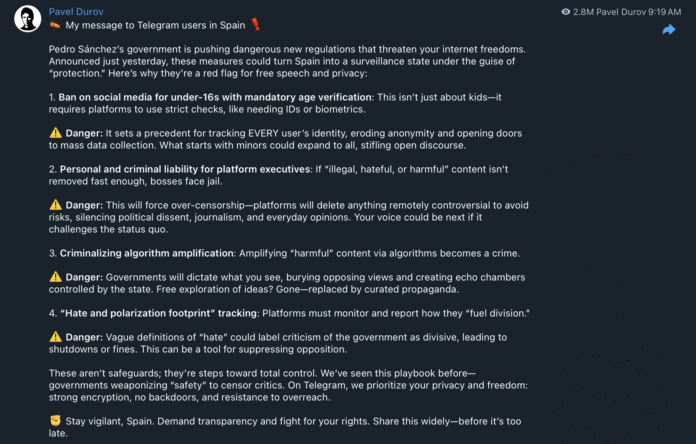
Pavel Durov, co-founder of messaging platform Telegram, has expressed concerns over the Spanish government’s proposal to introduce online age verification and restrict social media platforms for individuals under 16. The proposed law aims to protect children from harmful content, but Durov warns that it will lead to increased state-imposed censorship of online content, violations of privacy through de-anonymization of users, and mass surveillance.
The Spanish Prime Minister, Pedro Sánchez, announced the plan to introduce online age verification policies similar to those in other parts of Europe, including the United Kingdom, at the World Governments Summit in Dubai, United Arab Emirates. Sánchez stated, “Social media has become a failed state. If we want to protect our children, there is only one thing we can do: take back control.”  Source: Pavel Durov
Backlash from Privacy Advocates and Cypherpunks
Privacy advocates and cypherpunks have criticized the proposal, arguing that it limits freedom of expression and gives governments more power to censor content for political reasons. Critics argue that age verification is about control and not about protecting children. “You want to control people who expose corruption in your government,” a user named Campari responded to the announcement. Billionaire Elon Musk also reacted negatively, ridiculing Sánchez.  Prime Minister Pedro Sánchez announces that Spain will introduce online age verification guidelines. Source: Pedro Sanchez
Journalist Taylor Lorenz urged people around the world to fight against online age verification laws, stating, “None of this is about ‘protecting children.'” Others, like Boris Bohrer-Bilowitzki, the CEO of Layer 1 blockchain Concordium, argue that while protecting minors from harmful content is necessary, current age verification methods are counterproductive. Bohrer-Bilowitzki suggests that blockchain technology should be used to prove identity in a cryptographically secure way without revealing the specific content of a user’s identity.
Alternative Solutions and Concerns
Current age verification methods encourage users to bypass controls by using virtual private networks (VPNs), which mask IP addresses by routing online traffic through servers distributed in different locations. This raises concerns about the effectiveness of the proposed law in achieving its intended goals. Moreover, the use of blockchain technology to verify identity could provide a more secure and private solution. As the debate continues, it is essential to consider the potential consequences of such regulations on online freedom and privacy.
For more information on the topic, readers can refer to Magazine: When Privacy and AML Laws Conflict: The Impossible Choice of Crypto Projects. Cointelegraph is committed to independent, transparent journalism, and this news article is produced in accordance with Cointelegraph’s editorial guidelines. Readers are advised to independently verify the information. Read our editorial policies https://cointelegraph.com/editorial-policy. Source: https://cointelegraph.com/news/telegram-pavel-durov-slams-spain-online-age-verification?utm_source=rss_feed&utm_medium=rss_tag_regulation&utm_campaign=rss_partner_inbound

