
MicroStrategy Responds to MSCI’s Proposed Policy Change on Index Inclusion
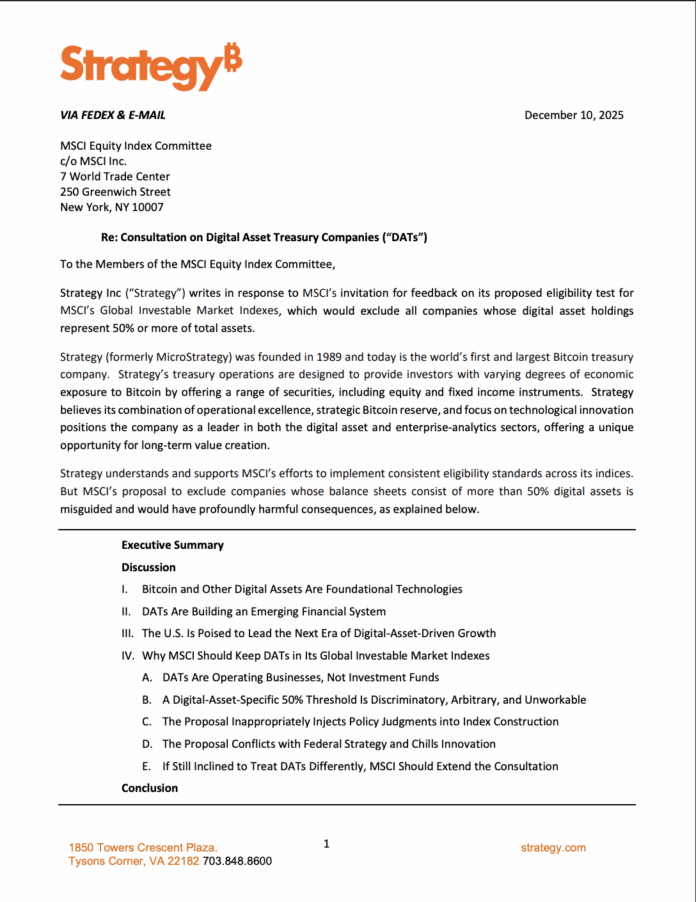
MicroStrategy, the largest Bitcoin treasury firm, has provided feedback to index firm MSCI on the proposed policy change that would exclude digital asset treasury firms holding 50% or more in crypto on their balance sheets from inclusion in the stock market index. The company argues that this change would put MSCI at a disadvantage compared to crypto as an asset class, rather than acting as a neutral arbiter.
Digital asset treasury companies, such as MicroStrategy, are operating companies that can actively adapt their businesses. For instance, MicroStrategy offers Bitcoin-backed lending instruments, demonstrating their ability to innovate and evolve. The proposed policy change would unfairly target these companies, which are capable of growth and development, unlike traditional investment funds.
The letter from MicroStrategy to MSCI highlights that the index firm does not exclude other types of companies that invest in a single asset class, including real estate investment trusts (REITs), oil companies, and media portfolios. As the letter states, “Many financial institutions primarily hold certain types of assets and then pool and sell derivatives backed by those assets, such as residential mortgage-backed securities.” This inconsistency in treatment raises questions about the fairness and neutrality of the proposed policy change.

On the first page of MicroStrategy’s letter to MSCI, the company objects to the proposed change in eligibility criteria. Source: MicroStrategy
Risks and Concerns Surrounding Crypto Treasury Companies
MSCI argues that crypto treasury companies exhibit characteristics of investment funds rather than operating companies that produce goods and services. The lack of clear and consistent valuation methodologies for cryptocurrencies makes proper accounting a challenging task and can potentially distort index values. This concern is not unfounded, as the high volatility of cryptocurrencies may increase the volatility of the indices that track these companies or create correlation risks if the index performance were to reflect the performance of the crypto market.
According to a Federal Reserve paper, the “sharing” of leverage by crypto traders increases volatility and contributes to the fragility of crypto as an asset class. This volatility is evident in the performance of Bitcoin (BTC), which is 15% below its value at the start of 2025, when it traded above $109,000. In contrast, MicroStrategy’s stock has lost over 50% of its value in the last year, despite holding 660,624 BTC on its balance sheet.

Volatility of Bitcoin and Ether compared to stock indices, oil, and gold. Source: The Federal Reserve
Implications of the Proposed Policy Change
MSCI’s proposed policy change, set to take effect in January, could result in treasury firms divesting their crypto holdings to meet new index eligibility criteria, creating additional selling pressure in digital asset markets. This could have far-reaching consequences for the crypto market and the companies operating within it. As MicroStrategy’s letter to MSCI emphasizes, the proposed change “undermines” US President Donald Trump’s goal of making the United States the global leader in crypto.
For more information on this topic, please refer to the original article on Cointelegraph.

