
Introduction to the Infinite Money Glitch
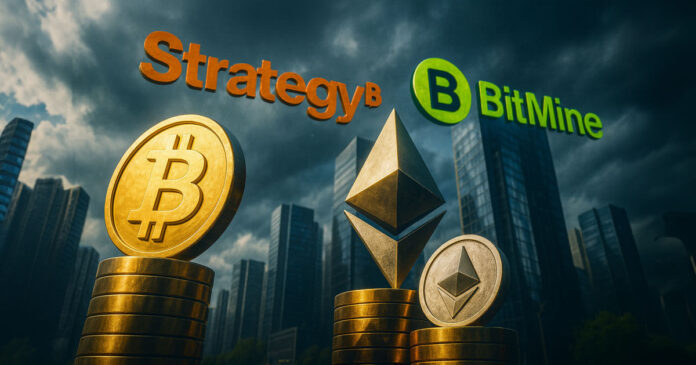
The two largest crypto treasury firms, Bitcoin-focused Strategy (formerly MicroStrategy) and Ethereum-focused BitMine, have made significant expansions to their digital asset treasuries despite falling premiums. On December 8, Strategy announced that it had acquired 10,624 BTC for $962.7 million last week, its largest weekly issuance since July. Similarly, BitMine, Ethereum’s largest corporate holder, added 138,452 ETH to its balance sheet. These acquisitions come as the broader Digital Asset Treasury (DAT) model faces structural stress.
Your Mechanics Under Stress
The latest acquisition brings Strategy’s total holdings to 660,624 BTC, representing more than 3% of the total Bitcoin supply. At current market prices, this position is worth approximately $60 billion and includes more than $10 billion in unrealized gains. However, the financing mechanism for this growth faces immediate threats. The company funded its recent purchase primarily by issuing common shares, a tactic that only generates value when the company trades at a premium to its underlying assets.
For years, Strategy used a recursive loop that allowed it to issue shares at a premium, buy Bitcoin at market price, and increase the value per share. This model was based on dynamics. Bitcoin’s strength created equity demand, and equity demand funded further BTC acquisitions. However, this reflexivity now fails. Bitcoin has retreated from its October peak of $126,000 and has consolidated between $90,000 and $95,000.
Return versus Store of Value
While Strategy advocates a store of value thesis, BitMine is making a shift towards a yield-generating sovereign wealth model. The company’s Ethereum accumulation has accelerated after a slowdown following the October 10 liquidation, a disruption that depleted derivatives liquidity and unsettled broader markets. BitMine now holds 3.86 million ETH (approximately 3.2% of circulating supply) and is accelerating purchases to reach a self-imposed “5% ownership threshold.”
BitMine intends to convert these holdings into a network-native revenue stream through staking, with a validator scheduled to launch in 2026. The company expects a treasury of this size to generate annual returns of more than 100,000 ETH at current prices. This approach differentiates BitMine’s solvency model from Strategy’s. The strategy is based on increasing the value of the collateral and a permanent premium to maintain operations. On the other hand, BitMine creates a solvency model based on future cash flows.
Abolition of Access Arbitrage
Meanwhile, both companies are grappling with a structural challenge that goes beyond price action: the commercialization of crypto access. The introduction of spot ETFs in early 2024 gave the DAT model a temporary boost in relevance, but capital flows have recently reversed. According to Coinperps data, the total assets under management of U.S. spot Bitcoin ETFs fell by nearly $50 billion from a peak of more than $165 billion in October to just $1,118 billion, before recovering to $122 billion as of press time.
This significantly flattened the market structure and eliminated the distribution gap that previously justified paying premiums for DAT shares. Therefore, Capriole’s data suggests that no new DAT formations occurred last month. In addition, the data shows the first signs of a dissolution of the treasury among smaller market participants.
Conclusion
The purchasing activity of these companies indicates conviction, but also illustrates a structural imbalance. The company Strategy, led by Michael Saylor, defends the mechanisms of its emissions model. On the other hand, BitMine defends the timing of its future returns. Essentially, both companies operate in an environment in which the premium that provides the essential fuel for their expansion contracts increases with each quarter.
With this in mind, their future depends on three variables, including the resurgence of crypto demand in 2026, the stabilization of NAV premiums above parity, and the realization of corporate flows from tokenization. For more information, please visit https://cryptoslate.com/the-infinite-money-glitch-fueling-strategy-and-bitmine-has-evaporated-forcing-a-desperate-pivot-to-survive/

